 Steve Elias, MD
 Charles E. Miller, MD, FACOG
Grow Up and Ring Them Bells
Reflections on AI, innovation, education, and the importance of thoughtful progress in venous care.
I didn’t know what pueri aeterni meant. And I could have just continued to read on. But it bothered me. I could guess, but why do that?
The writer, Maureen Dowd, certainly purposely used those words to make a point. Her article was about AI and the scary things that are happening and could happen. Her sentence read, “The pueri aeterni of Silicon Valley have…”.
So, to Google I went. The answer machine. I could have used ChatGPT or Claude or any other AI platform. I guess I am old school; Google it was.
Pueri aeterni: the eternally youthful.
Jung defined a pueri aeternus as a person, usually a man, who remains in an adolescent mindset well into adulthood. As with almost anything there are positives and negatives about being pueri aeterni.
I think Maureen Dowd was not depicting the “frat boys” of Silicon Valley in a positive light. One needs to be a grown-up to understand the nuances of AI.
I’ll be honest, the AI thing is overwhelming. To me, the more I read about it, the more confused I feel. The good and bad are both equally scary.
Information, Education, and Collaboration
But scary is not what we strive for in Vein Specialist. Our goals are information, education, and collaboration.
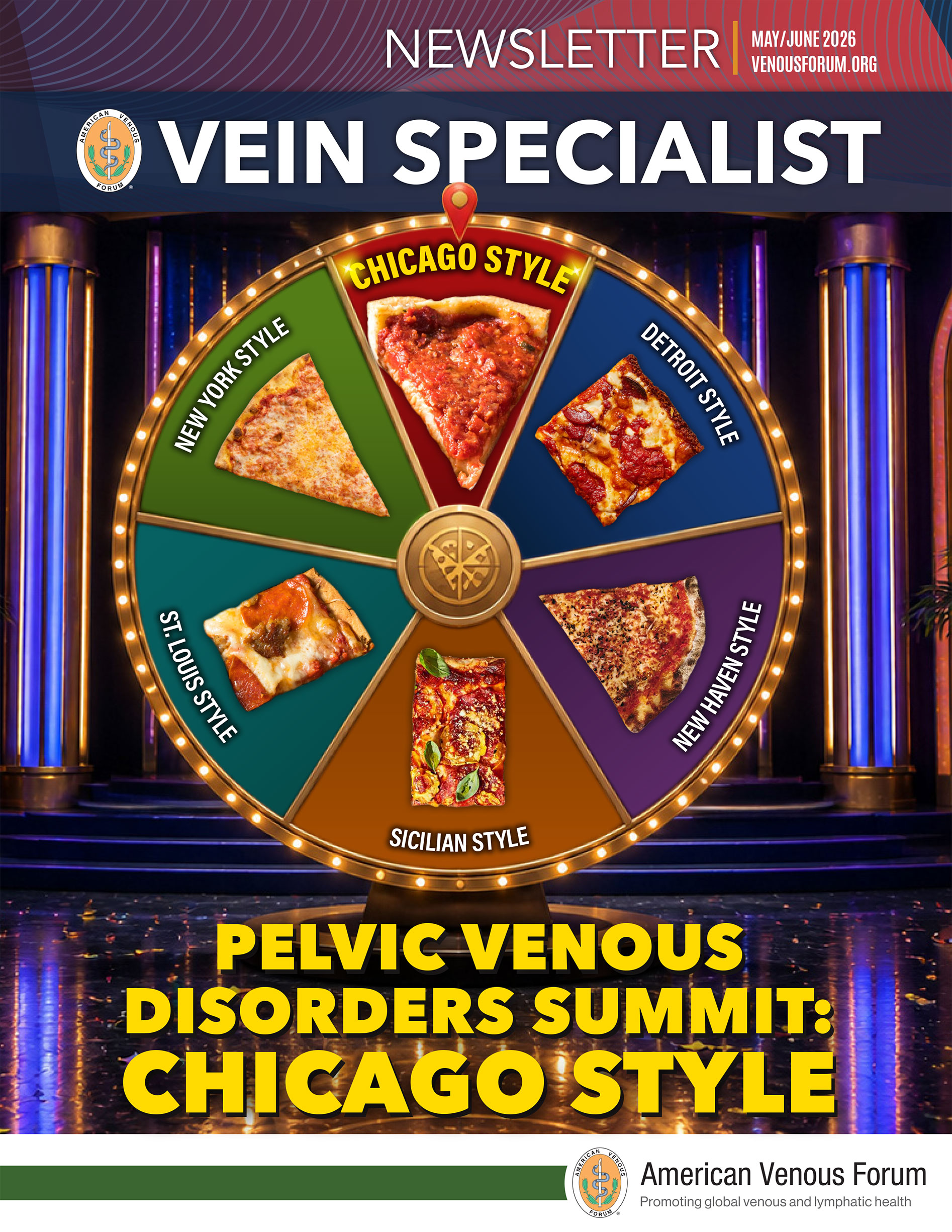
In this issue we cover extensive education and information regarding pelvic venous disease. Our experts discuss diagnosis, crossover symptomatology, treatment, and simplified understanding of the SVP classification system.
Regarding collaboration, we also cover two important trials: C-TRACT and EMBOLIZE.
Finally, the inaugural Pelvic Venous Summit is taking place — an important educational initiative developed to advance understanding and discussion around these patients and treatments.
The Pelvic Venous Summit has taken a tremendous amount of work to develop, and we need this education now. You need to think about these patients whether you ultimately treat them or not.
Attend and give it some thought.
Bells, Innovation, and Progress
But I never thought much about bells — kind of took them for granted: church bells. Their sound harkens back centuries. Bells marked daily time and signaled important events.
During World War II many went silent. The Nazis confiscated almost 175,000 bells. It wasn’t the sound they disliked; it was the metal — copper and tin — that they wanted for weapons.
The decree by Hermann Göring was “Reclaiming All Bells For War Purposes.” Quite presumptive. When something is reclaimed, it implies it was once yours and not someone else’s.
Well, Hermann always did have an egocentric outlook on life.
Necessity is the mother of invention.
After the war, campanology and campanologists came to the rescue. The bells needed replacing. Bell foundries were encouraged to create better bells.
Just as new and improved technology enters the vein world, so it was with the bell world. The new bells sounded better, lasted longer, and even took on new shapes.
Bells have never sounded or looked better. Research about bells is still ongoing, just as research supported by the AVF continues to evolve.
Professor of Campanology Percival Price from the University of Michigan — are we surprised? — helped create databases of tonal properties from surviving bells to engineer even better ones.
Bell-making is booming. AI is booming. AVF is booming.
This issue of Vein Specialist shows you how much. So read this issue, grow up, and ring them bells.